Introduction:
Africa is at a junction point in its quest to address the five significant areas of: Breaking the cycle of poverty, Conflicts & their resolution, Leadership and Governance, Socio-Economic Development and HIV/AIDS.
The Principle challenge to Africans both with in and outside will always be the identification of Africa’s strategic position on the global priority list, develop an economic blue print that integrates Africa into the global economy through Trade and not entirely on AID and a continental consciousness that Africa is our motherland. Diasporians armed with their level of exposure, will need to understand the effect of the geo-political system driven by capitalism and appreciate that Africa will find no favors from the corporate world whose desire is for acquisition of natural resources, even by force if it comes to that, to oil their respective economies.
Globalization is an Irreversible key epicenter in any intellectual dissection of Africa’s potential and the role young African Diasporians must play in order to increase the momentum of Africa’s road to sustainable development.
Economic “globalization” is a historical process, the result of human innovation and technological progress. It refers to the increasing integration of economies around the world, particularly through Trade and financial flows. The term sometimes also refers to the movement of people (Labor) and knowledge (technology) across international borders. Globalization involves the opening of economies (and thereby societies) to global market, as a result of present and the prevalent capitalist system. It was founded on such principles as deregulation, liberalization and privatization. Despite its benefits, with no safety nets, it has resulted in not only the economic displacement of peoples but more importantly, the obliteration of entire cultures and societies.
Situational Analysis:
Africa’s economic crisis began in the 1970s.African governments took advantage of readily available International loans but, in many cases, lacked the expertise or institutions to ensure they were used for priority development projects. Unfortunately, substantial portions of these loans found their way into the pockets of the corrupt, privileged members of society and unwarranted massive military spending as a result of the Cold war. By the end of the 1980s, most sub-Saharan countries were forced to devote between 40-82% of their earnings to redeem their foreign debt. Africa’s debt burden compared to its economic size is twice as large as that of any other region. 33 African Countries are classified as heavily indebted.
Trade performance across the African continent varies greatly. Although Mauritius and Botswana have grown, most African Countries have been stagnant or have retarded since 1980. Among others factors, this is related to the colonial legacy and a concentration of exports in Agricultural commodities that have rapidly de-valued such as coffee. Economic globalization has also exposed African Countries to the rules of a global Trading system defined by wealthy nations. Devaluation of Agricultural commodities on the Global market results in reduction in general consumption, take children out of school, and reduce spending on healthcare. In Uganda, women, children and young people do suffer and the result is rural-urban migration in search for work.
Adjustment policies introduced by the IMF/World Bank strongly encouraged participating African Countries to adopt free trade policies. As a result, African economies are the most open in the world. Powerful corporate economies have taken advantage of this as they continue to protect theirs own markets. In 1990, the IMF classified 75% of African Countries as operating “restrictive” trade regimes, with none classified as “open” (referring to whether African markets to foreign products and investment). In 2002, the IMF refers to only 14% of African trade regimes as “restrictive”, with 43% now classified as “open”.
In 1999, the organization for Economic Cooperation and Development (OECD) reported that Africa receives $21 per person in aid per year. By contrast, Oceania received $196 and Europe received $38. From 1991-1999, the percentage of total aid going Africa dropped from 37% to 26%. Despite the continuous flow of aid, Africa’s wide spread problems show little sign of lessening. It has become clear that aid despite its good intentions, is not the silver bullet to Africa’s social problems, partly because of the way its been used. Neither the local people, nor young people, have been significantly involved in the design, Implementation or evaluation of development programs and projects.
In response to pressure from the IMF/World Bank, as well as the need to repay debts, major changes have occurred within the Agricultural industry. Small-scale farmers in Africa are now in competition with large commercial Estates. As a result, young farmers have moved off land as agriculture becomes less viable. These changes have led to a decline in crop varieties, and an increase in water use, food insecurity and commercial fertilizer.
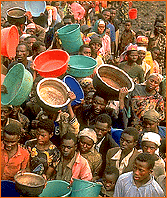
Children, youths and women in Africa are growing up in an environment where the quality and quantity of food is insecure, resulting in mal-nutrition and loss of life. The causes of Southern African food crisis are complex and vary from Country to Country. In different proportions they reflect a mixture of poverty and vulnerability, bad weather, poor governance, bad advice from donors and economic collapse. High rates of HIV/AIDS and other disease have further sapped the people’s ability to cope breeding conflicts in Africa. Donor driven policies of liberalizing African food productions have been especially controversial, with evidence that they have made it more difficult for Africans to grow more food or to afford to buy it, while in Zimbabwe drought and land reform policies have contributed to a collapse of food production.
Economic colonialism in Africa has compounded the existing theft and exploitation of vast natural resources with inadequate environmental regulations, and the relative powerlessness of local communities when faced with foreign corporate interests.
Factors associated with HIV infection include a lack of adequate healthcare, low levels of education, poor living conditions, and limited access to basic services, rapid urbanization, unemployment and poverty. In a sense, poverty is exacerbating AIDS, and AIDS is exacerbating poverty. The number of people infected with HIV/AIDS has reached an estimated 36 million. Approximately 95% live in developing nations and 70% in Sub-Saharan Africa alone. The global HIV/AIDS prevalence rate was 1.07% in 2000; while for sub-saharan Africa, the average was 8.57%.
Effects of Globalization:
We all recognize that the effects of globalization have been uneven, especially for Africa relative to Asia & Europe. Indeed, some argue that globalization has worsened inequality in the world, eroding the incomes of the poor and increasing their vulnerability. Africans today feel more marginalized by globalization and excluded from international trade and financial flows. They argue that the gap between the richest and poorest countries has widened in the last four decades as the continent has fallen further and further behind the rest of the world. Western tariffs discriminate against the local processing of commodities such as Cocoa, coffee and cotton. African goods sold in the OECD countries face tariffs roughly ten times higher than those levied on goods traded with the OECD. Ineffective policy prescriptions from the IMF/World Bank bear little reality to local conditions and the needs on the ground. Africans argue that the continent was in fact, better off before the reforms. They complain about the poor response to the HIV/AIDS pandemic and other diseases and inadequate and effective financial support from the donor community.
Net private direct investment to Sub-Saharan Africa was only $3.9 billions in 2002, most of it directed to exploit the continent’s natural resources, despite the often-stated fact that return on FDI in Africa is higher than in any other region. As many watch the progress of other countries through vastly improved international communication links, Africans have become increasingly bitter and disappointed with their governments and with the world at large. Many respond by desperately seeking to leave the continent to find better lives in those Countries that have benefited most from globalization, creating a new socio-political challenges, not for Africa alone, but the world at large.
The above analysis gives a desperate but partly the real picture on the ground reflecting Africa as continent suffering from mass economic and psychological depression. The thrust for people to migrate to Europe, America and Japan is as a result of the poor economic conditions imposed on the continent by the global system. The economic stress on the continent as a result of the above has caused Africa being characterized as a conflict prone continent whose security, given the HIV/AIDS epidemic and poor economy, losing any guarantees. The effect of the causes of immigration of Africans to Europe still standing will always keep diasporians away from home, keep them fragmented even in Europe or America due to an artificially configured corporate system that cares much less in addressing the huge brain drain. In other words, the current global order has not prioritized in addressing Africa’s development challenges and not rightly if has attempted to through it’s IMF/World Bank AID machinery.
Governance in Africa:
This sadly, is what one hears most in the debates at home. These reactions, however, over look some significant positive effects of globalization that are shaping the future Africa. The first is good governance. One of the most durable effects of globalization has been the growing recognition across Africa that good governance at all levels is the essential starting point to economic progress. Globalization has helped Africans better appreciate the importance of their democratic rights and to aspire to proper functioning democratic systems that respect human rights and the rule of law. There is therefore a strong push to develop political systems that promote representative and honest governments. Governance in Africa is slowly improving and decentralized government taking hold. For example, no incumbent African leader ever lost an election until 1982. In the 1990’s 12 African leaders were voted out of office and 11 more since then. Countries like Nigeria, South Africa, Senegal and Ghana are showing the benefit of democratic governance, rule of law and freedom of expression. Press freedom is growing, along with over all level of political activity in many Countries. While many problems remain, established standards of good governance arising from globalization are progressively taking hold in Africa.
With this has come greater economic liberalization. Governments in Africa are taking steps to privatize and de-regulate their economies to attract more private capital. The Ghana stock market for example, was the best performing stock market in the world in 2003 and continues to record strong gains along side the Nigerian stock market. The financial markets in Africa are progressively being deregulated and strengthened, the telecommunication and Information technology sectors are growing rapidly, new investment and mining codes are being passed into law to attract international capital, governments are implementing privatization programmes in the transportation and energy sector and legal and institutional frameworks for business are being strengthened. While not obvious to many, these developments have gone unnoticed to the international investors. Slowly but progressively, Africa is being looked at more closely for the investment opportunities that it offers in financial services, agriculture, outsourcing, telecommunication and natural resources. In response to these trends, the informal economy in many countries is also growing rapidly to capture the large reservoir of entrepreneurship and innovation that exists in this sector.
Education in Africa:
Another positive effect of globalization has been its impact on education. African governments increasingly recognize that Countries, which have benefited from globalization, have significantly invested in education. While most countries still lack the resources to establish a robust educational Infrastructure there is greater awareness of the role that education must play for the future and of the standards that must be achieved. Although still inaccessible to most, the Internet and other advances in information technology have opened up opportunities to improve the quality and content of educational programs. The effect has been a growing shift away from a reliance on the state to provide education, towards private schools and colleges. Governments are paying greater attention to education standards and enrollment. Gambia and Uganda for example, have registered 20% growth in primary school completion rate in the last decade alone.
Migration in Africa:
One important effect of the movement of people and ideas in a globalized world has been the growing number of Africans seeking educational opportunities outside the continent. This has been happening over several years and I believe that we are starting to see a trend where such educated Africans are increasingly turning their attention to the opportunities at home. Examining the number of financial and Information Technology companies being established back home and the trend becomes obvious. Furthermore, this “Diaspora effect” is making a major contribution to the economies of African Countries. Remittances to Africa from the Diaspora currently far exceed the levels of over-seas development assistance and have the potential to provide significant amount of capital to stimulate the growth of industries such as technology and real estate. The efforts to promote increased regional Integration is another important step towards greater participation in global markets by African Countries who recognize the pressing need to pool their resources and markets to create the scale and opportunities that can attract International capital and investment. African leaders have signaled their commitment to this process with the launching of NEPAD, which has as one its goals the need to “ halt the marginalization of Africa in the Globalization process”.
Against this background, one must ask the complex question: Why has Africa been marginalized? The theories are many, but the answers can help fashion initiatives and policies and policies to correct the errors of the past. While one can start from the history of colonialism, which created artificial, weak and unprepared nation states from the time of independence, and from the effects of the cold war, history cannot today justify Africa’s lack of progress in the last few decades. The prime culprit in my view is poor governments and the corporate economies. Africa has not been blessed with good governments and effective leadership to realize their responsibility in addressing, in one voice, the challenges of the imbalanced global trading system imposed on the world by the corporate centers, America, Britain, France, Germany, Japan, Italy and all their allies. Political systems and the quality of public service through which policies are implemented remain weak due to a small Human Resource Base. Economic governance, characterized by measures to combat corruption, promote better-functioning bureaucracies and better regulation has been poor. The delivery of education and health services has fallen well short of international standards. Africa’s debt burden has made it difficult for policy makers to address these weaknesses and to implement forward-looking economic policies. Furthermore, the current international trade architecture, focused in Africa primarily on agricultural products, makes it extremely difficult for Africa to grow through increased trade.
Achieving sustainable economic growth and poverty alleviation and the improving the quality of life through private and public sector Initiatives requires an Integrated effort of both Africans at home and brothers and sisters abroad. The mechanism and measures required helping African Countries take the right steps to benefit stem from the positive aspects of globalization, while minimizing the negatives and ending the continent’s marginalization.
My observation is that the current development consensus for Africa is weak in a number of important areas. First, it does not give enough attention to the administrative and Institutional capacity of governments in Africa to develop and implement sound reforms and initiatives. Simply put, most governments are administratively and technically too weak to manage their Countries. Substantial resources are therefore required to upgrade the caliber of people in government and to attract the best minds back home. This is ironic when one considers the impressive resources that are increasingly available to African countries from their own nationals now in the Diaspora. These resources are not harnessed and that is a priority, governments need to be more efficient. Today officials are overwhelmed and bogged down with too many issues from too many constituencies, including the International donor community and the multilateral institutions. They are paralyzed into inaction and have little time to develop strategies to improve their countries, much less to actually manage the programs that they sign up to.
Secondly, inadequate attention is given to the development of strong legal, financial and regulatory systems that underpin efficient governments, especially at the local level. Thus existing systems are abused through inefficiency, mismanagement and corruption. Most countries simply lack the capacity to upgrade the systems. As an example, despite the stellar performance of the Ghana stock exchange, it still lacks the resources to automate its operations and upgrade its rules and regulations to meet current best practices so that it can play a more meaningful role in attracting private sector capital.
Thirdly, the approach to developing high quality educational systems in most African Countries is failing primarily due to funding, which has not kept pace with population growth. Educational reforms is proving too complex for many governments, with the resultants lack of proper basic, technical and vocational educational level training, which in turn, produces a workforce that is ill prepared to the demands and challenges of globalization.
In summary the agenda and approach, to Africa’s development dilemma from the eye of a Ugandan is therefore superficial in the areas that count most. Government simply cannot implement all the programs and projects from development partners, no matter how well meaning. On their own, most of these lack the necessary depth, scale and sustainability to make a difference and because implementation is often a problem, the response has been to send down armies of consultants from the donor countries to implement them, in the end absorbing substantial portions of the available funding.
The agendas therefore need to be pared down and concentrated more on institution building, attracting high caliber talent, strengthening education and building an effective financial and regulatory infrastructure. When progress is made in these areas, I believe Africans on their own can develop the strategies that will allow them to achieve sustainable growth and progress in today’s globalized world.
The Initial thrust in achieving sustainable development, the diasporians as well as their brethrens back home need to address the following from a strategic perspective:
Support the best of existing work on Africa, in particular the New Partnership for Africa’s Development (NEPAD) and the African Union, and help ensure this work achieves it’s goals. The African leadership has made some progress and the African people have realized the need for good governance and aspire to achieve that end. Programs have been developed which indicate an awareness of the direction that must be taken to engage the international community on Africa’s challenges. Programs such as NEPAD must be supported to help deliver implementation of existing International commitments towards Africa.
Offer a fresh and positive perspective for Africa and its diverse culture in the 21st century, which challenges unfair perceptions and helps deliver changes; and
Generate new ideas and actions for a strong and prosperous Africa, using the 2005 British Presidency of the G8 and the EU as a platform. The British leadership seems interested in playing a more constructive engagement of Africa’s challenges, involving diasporians and the African elite class to give her a forward thrust in tackling her problems.
Understand and help fulfill African aspirations for the future by listening to Africans
Diasporians through Institutional, organizational or Individualistic efforts must focus on six areas pragmatically: Economy & trade, natural resources, governance, conflict and security, human development, and culture and participation.
Tackling the media Image:
Conceptually, diasporians just like their brothers back home need to “wrestle Africa’s” media image from the mainstream media. Mainstream media such as BBC do not produce programs specifically for the African communities. International media houses have specialized in non-balanced reporting leaving success stories, events or positive aspects such as climate, culture and tourism potential unreported internationally. The formation of a strong media agency such as Al-jazeera would help highlight the other side as a counter-weight as a damage control measure.
Dual or Multiple Citizenship:
Dual or multiple-citizenship must be accepted as another aspect globalization and diasporians must take it on board so that an individual can be a citizen of one Country and linked to others. This would break barriers created by visa restrictions and fully improve investments inflows towards Africa.
Networking & Improving Contacts:
Diasporians through institutional frame-works and networks should improve their diplomatic footwork in influencing International Institutions and host governments in order to isolate despotic governments back home in Africa. Europeans banks that have been safe havens for ill-gotten money should be legally restricted through legislation in the European Parliament and the United Nations. This requires vigilance from diasporians, civil society and cooperation from western governments. International legal restriction should not be an issue only when Al-quaeda hits America and kills 3000 Americans but also when African kleptocrats connive, rape and defraud their people in cooperation with International Banks with the help of western governments, who by the way lend African governments the money.
Diasporians need to, organize and mobilize the African community and co-ordinate activities by developing networks, databases of information about existing activities, develop a platform for engaging the International community by highlighting Africa’s development challenges. This will be possible when a think tank is put in place as a process to set up the lobby group. The lobby group should be charged with a double role of engaging the International community as well as Africa governments specifically as a communication link in addition to others already in existence. The lobby group would help in networking Africans abroad to invest back home through joint ventures not just personal initiatives. It would help promote links with each other and Africa. Help hold in-depth discussion on issues and set measurable and achievable goals. Help the formation of networks at professional level where professional can influence mechanisms and seek change in securing access to capital. The lobby group would champion and re-enforce already existing demands for Africa achieving a more balanced global trading system and improve the media image of Africa in the International community.
Diasporians as economic players in their host countries will need to identify their power as consumers and producers, taxpayers to promote Africa ideas, goods and services through formation of an African Business forum both in Europe and America as a tool to achieve leverage in Trade negotiations at international and national level.
Human Resource Development and Health:
Discussions on skill transference and training should also be a focal point where retired civil servant diasporians can be given incentives to come back to Africa to re-enforce the effort to build human resource capacity as an object to build institutional capacity of government and civil society organizations. Western government through discussions in international diplomatic engagements with diasporians can finance this effort as the UNDP has initiated so far, though with minimal impact and desirous of more momentum.
Overtime, remittances from individuals for both individual consumption and investment in Africa has increased and seems to be the highest foreign exchange earner beating the traditional exports like Coffee in the case of Uganda. There is need for secure financial Institutions through which monies can be remitted back to Africa for investment. Investment in vocational education as a tool to gate way young Africans into the global job market is also important.
There is need to prioritize in social service delivery in particular education and health. African governments with the support of the private sectors can get a boost from diasporians as cores investors, technical advisors in the areas of technical education and health. Africa needs a health population to produce and this form it’s position in the near future as a strategic investment area since Asia, Europe and America are reaching investment equilibrium. Africa still in it’s economic virginity needs to strategically to invest in it’s human resource through education and health care service delivery to become tomorrow’s investment destinations.
Develop & Emphasize Local models:
Alternative models proposed aimed at Africa obtaining sustainable development are all based on external models and proposed without looking at African models and solutions. World Bank/IMF development policies aimed at integrating Africa into the Global Market have had both positive and negative impact. The negative impacts have been due to the object of unleashing capitalism on small economies without any element of a welfare state or alternative safety nets in Africa. The results have not been good and most Africans resent any enthusiasm in Economic liberalization thus unstable governments. In other words, African elites and the leadership must be constructively
engaged in policy development, Implementation and evaluation just like the intended beneficiaries of projects.
Regional Integration & Governance:
African countries will need to deepen their economic cooperation through regional integration; removal of artificial restrictions on the movement of African peoples and a thorough plan to create regional commerce will work through abolition of border tariffs and visa restrictions on the movement of African peoples. There is need to encourage the democratization and decentralization of the economic planning process. Governments should be encouraged to decentralize societal management. Local governments should have a role in the whole government economic planning process before the centers go ahead make budgetary processes. It must be an involving and consultative process for the beneficiaries to feel the total ownership of government programs, which eventually reduce the total cost of ownership.
On matters of governance, Africa will have to strengthen checks and balances across all sectors and develop effectives monitoring mechanisms. Civil society and community groups, which form the core voice of the very poor, will require more direct support. There should be need and commitment to enforce International gender equity conventions to ensure women’s active representation and participation in governance structures. An effort to focus on long term strategic planning by governments and institutions, strengthen the rule of law, protect civil and political rights.
Proactive Involvement in international Demonstrations:
There have been efforts aimed at exposing the effects of globalization through civil society campaigns like Oxfam Britain. Africa has a problem of the debt burden, which requires a comprehensive write-off. Africa too has little bargaining power at the WTO, which relegates it from global trade negotiations leaving discussions solely to the benefit of multi-nationals. Diasporians have not equitably played a major role in identifying the glaring impact the debt burden has played at decelerating the momentum for growth and development in Africa. There is need to mobilize the community of African diasporians to address this issue consistently in international forums as one of the hindrances to development in additions to trade imbalances.
Core Investments in Energy, Education, Transport & Communication:
In partnership with home/regional governments & the donor community, disaporians must attract core capital investments in regional, continental transport, energy and communication infrastructure in addition to strengthening the financial sector through both investments and stimulating legislations that create a good climate for investment.
Africa and Uganda in particular has a small skilled technical human resource base, which demands that Human resource development must be a priority for all development efforts. There is need to strengthen local languages through education and other initiatives to promote trade and integration. There is need to invest more in education by prioritizing our budgeting process, shifting resources away from military spending to social development efforts in Africa as a whole. There is every reason to invest more resources into vocational skilled training for young Africans as a tool of integrating them into the global system. Support more HIV/AIDS education and prevention initiatives. This will help mitigate the impact on Africa’s human resources and reduce HIV/AIDS impact on Africa’s strategic security and economic concerns. Encourage and invest more resources in to Universal Primary Education and life long learning as a tool of empowerment through grants, scholarships and infrastructural investment in education.
Integrating rural Africans:
There is need to support small-scale credit systems for local small enterprises stimulation in rural communities. Through micro-finance Institutions, re-invention of cooperative societies for small agricultural farmers will help integrate agricultural communities into the financial sector. Diasporians in collaboration with the small elite class in Uganda will have to assume the role of an intellectual think tank that will guide government develop policies that will have an economic trickle down effect and in the interest of their Countries. The need to pay attention of local specialized knowledge cannot be under-estimated in this approach. This will help bridge the gap between the highly technically skilled African from the corporate world and the local artisans and specialists of the local conditions on ground.
Land for Investments:
Africa still faces conflicts caused by a number of factors and land till, strong legal instruments are developed will remain one of the precursors of overt and latent conflicts. Land for investments will be of great necessity since it’s a factor of production. Strengthening of ownership of land with legal provisions for user rights and ownership will help create the necessary conditions for investments in Africa.
Natural Resources Exploitation:
The elite that form the leadership in Africa will have to develop a mechanism for effective and efficient exploitation of natural resources for the benefit of local people. Local people should own natural resources and some profits ploughed back into social service delivery to the local communities. As exemplified by the Oil Delta region conflict in Nigeria-the conflict was due to the resentment by the local people that they were not benefiting from the natural resources from their land. Companies should be encouraged through legal instruments to make social audits of investments outcomes, enforce environmental protection laws in order to remedy negative consequences of natural resource exploitation. Governments should stimulate investments in renewable energy by giving incentives in research. Infrastructural growth to facilitate natural resource exploitation should be a core strategic investment effort for African governments, the donor community and the diasporians. The promotion of corporate social responsibility, investment in value addition of agricultural products, access to international markets and the demand for accountability and transparency from multinational corporations will be a conscious effort by the African people and their friends to harness their resources equitably and sustainably for development.
Diasporians with Africa’s Diplomatic Corps:
Diasporians will have to engage Africa’s diplomatic corps in the corporate world to play a more constructive role in improving the image of Africa and discuss with them how governments back home can help create incentives for diasporians ploughing money back home for core investments. They will need to support technically institutions in Africa through capacity building. Support and promote African role models and achievers. They will need to examine the effect of African emigration on Africa’s development. The Diaspora will have to lobby western governments to establish an African community development chest to assist individuals and groups, particularly through not exclusively the African Diaspora, who wish to contribute to community development in Africa. The lobby groups in a network will have to lobby and pressurize western governments to adapt immigration and asylum policies to alleviate the problem faced by individuals and families from countries of conflict and open up more avenues for migration for the purpose of economic activities.
Culture & Participation and Conflicts resolution:
Cultural diversity and preservation for the benefit of the African community will be another important aspect. Promotion of awareness of African heritage and highlighting the return of the African treasures and artifacts and protection through copy rights will go along way to reposition Africa into the World as an investment desitination. Education and youth empowerment through culture and the search for more positive space in the media on Africa will help in boosting tourism and in turn bring in foreign exchange. Encourage student exchange with in African and between Africa and the Diaspora through sponsorship. Promote role models of Africans as achievers and mentors and address the need to modernize African culture where there is need. With a reduction in economic stress, investment in-flows improving and production going back to normal Africa will experience fewer conflicts.
Bibliography:
Jacque-Chai Chomthongdi, “The IMF’s Asian Legacy,” In Praque 2000:Why we need to Decommission the IMF & The World Bank
“Zoellick says FTA candidates must support US foreign Policy” Inside US Trade, May 16 2003. This article summarizes a May 8 speech by Zoellick.
George Soros, “America’s Role in the World,” Speech at the Paul H.Nitze School of Advanced International Studies, Washington, DC, March 7, 2003.
Frances Fitzgerald, Fire in the Lake (New York:Random House,1973)
Join Africa’s Brain Drain,Or Rot at home, East African Publication January 3, 2005 by Charles Onyango Obbo.

 You want to know the African Voltage?You want to know what makes us happy people? Welcome to the Volts. The African voltage symbolizes that innate traditional way and energy of expressing what we know we own and have inherited over generations from our ancestors. This cultural heritage expresses our resolve to adhere to our traditional roots in dealing even with modern challenges.
  Yes, there is an evolution as the world globalizes and yes we recognize these changes but there is that natural voltage visible on the faces of our people and their resilience to challenges. The disagreements on whether states evolve or are engineered by revolutionary blends with the former are for pretentious sociologists to sort out. We have moved on with what belongs to us. In Africa it's about life in its natural state.I have gone around the world but the trip ends up back in Africa and Uganda to be specific. Despite all the hiccups of our political-economy engineered externally, despite all the pressures from imperialist interests that have diverted states from addressing their natural mandates,we have proved to be the most resilient people on this planet. Aboriginals, Red Indians have been reduced by what in modern history is termed as "the civilized" world. Ours has been a painful rediscovery from slave trade and colonial interference. There is alot that has been talked about in a stereotypical way about this continent.


 and its beauty. The chinese have and yes we can. The world faces an ecological catastrophe if America's cultural imperialism is not checked by other cultures.
  and its beauty. The chinese have and yes we can. The world faces an ecological catastrophe if America's cultural imperialism is not checked by other cultures.
 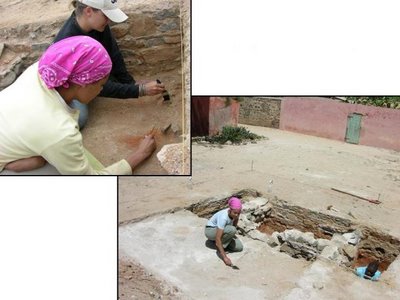 We have done our part to trace our history. Yes we are working on documenting what we have discored. It's a process that requires committment but the young ones have come forward and showed enthusiasm. All this goes a long way to show that Africa is a partner undermined by those who do not understand how the world works. That our grand children will be true partners of the world as we; in our time work to establish our true identiy in the new global order. We re-echoe our call to the world and those who have relegated Africa to the peripheral that we are a re-awakened giant that is slowly emerging as a global player. The resources we have is all you want and previously it was Western Europe's exclusive monopoly of access, now we can deal with those whose hand stretch out to us with respect. Let no one underestimate our resolve to protect our natural resources. It has gone on for long but today a moment has come for us to prove to the world that it calls for more respect to deal with us.
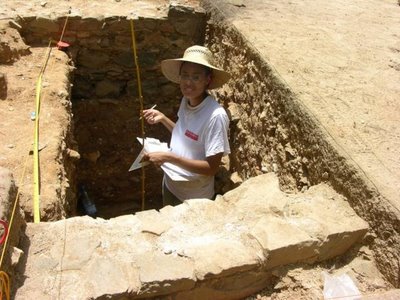 And you think I am joking? That is not a grave.It's an archeological excavation by an African student trying t
 o put Africa into perspective.
%20and%20Raina%20Croff%20(American)%20at%20work%20at%20Site%20GI-4b.preview.jpg) We have done our part to trace our history. Yes we are working on documenting what we have discored. It's a process that requires committment but the young ones have come forward and showed enthusiasm. All this goes a long way to show that Africa is a partner undermined by those who do not understand how the world works. That our grand children will be true partners of the world as we; in our time work to establish our true identiy in the new global order. We re-echoe our call to the world and those who have relegated Africa to the peripheral that we are a re-awakened giant that is slowly emerging as a global player. The resources we have is all you want and previously it was Western Europe's exclusive monopoly of access, now we can deal with those whose hand stretch out to us with respect. Let no one underestimate our resolve to protect our natural resources. It has gone on for long but today a moment has come for us to prove to the world that it calls for more respect to deal with us.
We have done our part to trace our history. Yes we are working on documenting what we have discored. It's a process that requires committment but the young ones have come forward and showed enthusiasm. All this goes a long way to show that Africa is a partner undermined by those who do not understand how the world works. That our grand children will be true partners of the world as we; in our time work to establish our true identiy in the new global order. We re-echoe our call to the world and those who have relegated Africa to the peripheral that we are a re-awakened giant that is slowly emerging as a global player. The resources we have is all you want and previously it was Western Europe's exclusive monopoly of access, now we can deal with those whose hand stretch out to us with respect. Let no one underestimate our resolve to protect our natural resources. It has gone on for long but today a moment has come for us to prove to the world that it calls for more respect to deal with us. And you think I am joking? That is not a grave.It's an archeological excavation by an African student trying t
 o put Africa into perspective.


 It appears that Heritage Oil and Executive Outcomes are owned by the same network of mercenary corporations that includes Branch Energy (reputedly a Heritage Oil share holder), ex-South African troops, and Canadian mineral extraction firms. Heritage Oil has operations in Angola, Congo-Brazaville, DRC, Oman, and Uganda. Executive Outcomes was involved in Sierra Leone, Angola, Kenya, Uganda, Sudan, Malawi, Mozambique, South Africa and Canada. Measures to curb the commercial fuel of the conflict have been suggested by the UN panel's report, which recommends reducing development aid flows to offending countries; tighter controls on the trade in conflict goods; travel bans on individuals; freezing of personal assets; and blacklisting of selected companies and individuals from dealings with international financial institutions. Mercenaries, now simply called "private military contractors", some of whom are subsidiaries of Fortune 500 companies in the USA, are violating the




 This population explosion can be explained from an ecological perspective but equally presents the most hidden strategic key to opening our door to the geo-global political system as agents of development rather than beings waiting for humanitarian interventions in perpetuity. The natural instinct that dictates genetic self preservation has induced Africans and Ugandans in rural communities into this wave of mass-reproduction. No population planning program has been able to decelerate the current reproductive rates among the illiterates in Uganda. No amount of HIV/AIDS has forced the very drenched of the earth from their natural responsibility of self-preservation. No amount of famine, draught, or violence has stopped the most vulnerable from re-producing and all this points to that survivorship phenomenon where many Africans and Ugandans find themselv
 Scientists in Europe now recognize another role of the Alps, like many mountain ranges with glaciers, as a barometer to asses the extent of climatic change and the> impact of global warming. In Uganda today, the Scandinavian nations have a massive environmental program which indeed emphasizes growing trees by the rural folks. Poor Africans will not grow trees because that is not their immediate interest. They do not even care what forests are for because they are illiterate. They also want land to grow food for their growing large families since they can't sell their produce anywhere.The increasing population of the poor and illiterate who form the most important agent of environmental degradation forms the epicenter of my discussion.
 A
A