Monday, February 12, 2007

Is Traditional Political Rivalry affecting Internet growth?

The extension of the Internet into virtually every branch of social and economic activity has led to growing public policy interest and sometimes concern as to how the Internet is managed and whether there is adequate accountability-not least in terms of respect of applicable laws. This development contrasts with the technological and academic origins of the Internet and with the tradition of self-regulation and noninterference on the part of governments.


The European Union has been part of this process during recent years. Christopher Wilkinson is at the forefront of trying to find the necessary balance-in Europe and globally-between the potentially contradictory requirements for the liberal self-regulatory regime of Internet governance, including the necessary flexibility and speed of response on one hand and the growing pressures for greater accountability, transparency, and conformity, at least with the principles of relevant local and international laws, on the other hand.In March 1998, the European Union (EU) responded to the publication of a draft proposal by the U.S. Department of Commerce for the technical management of the Internet domain system. In that document, the EU called for the future of the Internet to be agreed upon in an international framework, and it pointed to several policy areas of concern to European public authorities. Those policy areas included the need to implement an international approach to issues of jurisdiction, trademarks, competition policy, dispute resolution, and the scalability and portability of the Domain Name System (DNS). That public statement was one of the first regarding public policy interest in the organization and management of the Internet.


Following the response and other consultations with the White House and the Department of Commerce, the U.S. white paper published in July 1998 referred specifically to the global dimension of Internet management, and in due course, the Articles of Incorporation of the Internet Corporation for Assigned Names and Numbers (ICANN) addressed directly the applicability of local and international law. The principle of geographic diversity was endorsed and implemented in due course in the composition of the ICANN board and supporting organizations.


The ICANN Governmental Advisory Committee (GAC), meeting for the first time in Singapore in early 1999, also adopted a preamble to its Operating Principles that reflected the consensus of the governments present as to the scope of the public policy issues that should be within the remit of the GAC. One of those issues was the general principle that "The Internet naming and addressing system is a public resource that must be managed in the interests of the global Internet community." Since that time, the European Union has continued to maintain the importance of those principles. How do those matters stand today, three years later, regarding the scope of public policy and, secondly, regarding the nature of the responsible bodies?


The Scope of Public Policy
In a general sense, public policy is policy that is in the interests of the public at large and that is decided by bodies with public authority. However, the scope of such policies is not self-evident in the context of the Internet, wherein a high degree of private self-regulation has become the norm. Neither is it clear which bodies exercise the necessary public authority, particularly because the Internet itself has charged its own private entities-such as the Internet Engineering Task Force (IETF) and the ccTLD (country code Top Level Domain) Registries-with varying degrees of responsibility for the public interests and, consequently, for certain public policy interests as well. Indeed, ICANN itself is a private entity under U.S. (California) law, but certainly exercises part of its responsibilities explicitly on behalf of other governments, worldwide-by delegation from the U.S. government-and implicitly through the international composition of its board and through the GAC.


For the present purposes, we shall limit the discussion to issues that fall actually or potentially within the remit of the ICANN organization and its constituent bodies, including the GAC. This is clearly an arbitrary limitation from the point of view of public policy in general because it excludes-or should exclude-all content-related issues, such as cybercrime, copyright infringement, and commercial and fiscal fraud. The limitation is self-imposed in the interests of time and space, although burgeoning interest in the potential use of the Whois query services tends to belie that distinction.
Would the scope and emphasis of public policy in the context of Internet management be any different today? First, the initial cut in terms of the appropriate definition of the scope of public policy in this area has proved to be not too wide of the mark:
The importance of balanced international representation has been fully recognized and taken over as an article of faith by nearly all of the Internet and ICANN communities. The first steps in this direction on the part of the Europeans were quickly emulated by Asia and Latin America, and Africa, the Middle East, and Eastern Europe will no doubt follow closely in the foreseeable future.
Respect for local and international law has in practice been interpreted as including competition laws, intellectual property laws, and data protection and privacy laws. How this is implemented is to date not entirely satisfactory, notably because ICANN is confronted with significant differences between jurisdictions in certain areas of law and has not yet struck the right balance between its accountability to U.S. jurisdiction by virtue of its location and incorporation (and its contractual relationships with the U.S. government) and to international jurisdictions by virtue of the location of most of its international contractual partners, notably registries and registrars and the economic and social effects of its activities.


Characterizing the Internet naming and addressing system as a public resource by the GAC has also been an important foundation for guiding the organization of ccTLD Registries and their relationships with national governments and other public authorities. Among these policy issues, one could highlight the matter of competition policy and particularly the extent of ICANN's responsibilities as illustrated by the recent negotiations of the .com, .net, and .org agreements with VeriSign.Privacy and data protection is another example, wherein the desire to see a globally consistent Whois query service operating across all TLD registries and registrars is not readily consistent with the diversity of national data protection laws, at least in the European Union.
Other significant policy issues have emerged meanwhile that were not foreseen in 1998-99. For instance, the GAC has addressed the issue of geographic names and policy for ccTLD registries. Another case in point: the European Union institutions are working on a regulation to permit implementation of the .EU TLD registry. Naturally that text addresses the question of relevant public policy regarding such a ccTLD registry. The Commission's proposal pointed specifically to alternative dispute resolution and to preventing speculative and abusive registrations as areas of public policy. However, the European Parliament and the Council of Ministers have broadened the scope that now includes policy on revocation of domain names, issues of language and geographic concepts, and the treatment of intellectual property and other rights.


The extent to which ICANN would itself effectively create regulations governing the DNS through its contracts with registries and registrars was also not fully recognized at the time. Granted that ICANN obviously does have regulatory responsibilities, the question as to how those responsibilities are being exercised currently through the so-called bottom-up process is attracting the increasing attention of both private-sector players, whose businesses are affected by these regulations, individuals and non-governmental organizations, and by governments, which see this as a process that they would otherwise have to be carrying out themselves.


The Relevant Public Authorities
The second broad issue relates to which are the relevant bodies with the necessary public authority to exercise these responsibilities and how. It is already clear that in the global Internet it is insufficient to think only in terms of national governments and international organizations as normally understood. Already GAC principles engage in linguistic contortions to include several entities in GAC membership that are not, strictly speaking, national governments. The GAC has also recognized that the ITU and the WIPO have particular roles to play (as indeed did the initial IAHC set up by the Internet Society in 1997). The European Union itself, a full member of GAC, is constitutionally unique because it is neither an international organization nor a national government, but manifests characteristics of both.Although the GAC has a clear view of the importance of all of these public policy issues, its responsibilities are advisory, and that has led some governments to question whether the GAC can fill the bill or whether it is worth its time and effort to participate actively.


From the EU's point of view, we would argue that it depends crucially on how effective GAC is in preparing and presenting its advice in a timely manner and on how ICANN responds to the advice it receives. If public authorities fail to participate in the ICANN process through the GAC, they will effectively ensure that the advice is considered weak and is ignored. If ICANN fails to take adequate measures in the public interest, then it is clear that the governments will step in; in that event, it is essential that the EU be "at the table," should the need arise. This political fact has indeed been recognized explicitly by ICANN.


Indeed, many would argue that in practice, ICANN itself is now one of the bodies exercising public policy responsibilities. ICANN is recognized as a unique experiment and consequently is difficult to classify or characterize, but it clearly:
Functions as a sole regulatory coordinating organization for the Internet infrastructure. Since it functions as a global monopoly in its area of responsibility, it is important that it operate in the public interest and not abuse its position in any way. Whence the requirement for transparency, consensus, and potential review of decision-making processes.
Creates rules for the market for domain names and for the allocation of Internet protocol addresses that are increasingly implemented via contracts between ICANN and the registries and registrars. This contractual framework does not look like a system of regulatory law, but it has very similar effects because it affects a whole range of economic and legal issues, including prices, terms of conditions of registration, and dispute resolution.
Has a direct effect on the conditions of competition between registries and registrars, including determining whether the same company can operate as both a registry and a registrar.
Determines the basis on which registration data is made available to the public, including, eventually, personal data.
Determines, through IETF and IAB, the organizational framework in which the Internet technical standardization process takes place.
Strongly influences-through the ASO and the RIRs-the global policy for allocating Internet protocol address blocks-increasingly perceived as the essential basis for the whole of modern communications.
Consequently, even if ICANN strictly stuck to its last, narrowly defined, there is more than enough in /'the scope of its policy-making functions to garner the attention and occasionally the concern of governments worldwide. Furthermore, a corporate approach that is oriented principally toward the interests of major Internet operators-as increasingly represented by the supporting organizations-probably offers insufficient internal checks and balances to ensure the public interest worldwide. That is why ICANN has to give a very high priority to ensuring the adequate representation of public interests either within its own structures-notably through public interest directors, elected by the at-large membership and appropriately constituted-or through a very thorough and interactive relationship with governments.
Whereas most governments appear to be supportive of the principle of the individual membership of ICANN and at-large elected directors, this has not yet been discussed thoroughly in the GAC and most of them would also argue that for the foreseeable future, it is the public authorities themselves and not the at-large membership that constitute the relevant manifestation of the public interest.


At a time when the U.S. administration is appropriately relaxing its contractual controls over ICANN and progressively transferring authorities to ICANN-a process that is widely supported internationally-it is becoming increasingly important that the international or global dimension of ICANN's own decision-making processes be effectively strengthened, including in ways that can create and sustain the confidence of public authorities, worldwide, who see the Internet-and particularly the names, addresses, and protocols-as the most important element of the communications infrastructure and thus increasingly of the economy and society as a whole.Since there is no room for serious error, and here I echo Stuart Lynn's own words, ICANN cannot be surprised that governments ultimately see little distinction between an advisory relationship through the GAC and more active oversight, thereby permitting those governments to fulfil their own responsibilities to their societies, their legislatures, and their electorates.


Monday, January 22, 2007

Uganda's scenic beauty is her strategic advantage!

Welcome to my escapades in Kalangala Islands. One of the pics on the left is the cruise ship to our dream-land. On the right is one of our friends enjoying the beaches of Kalangala. But that is just the beginning of a mouth-watering adventure of nature. Uganda,oh my! This is day one of my trip to Kalangala Islands sitting right on L.Victoria. I love these things with a passion. The dense tropical forests are awesome. The freshness of the water, the strong breeze of untampered air is simply a dream come true to those anxious visitors. Yes, my travel to Ghana sometime in 2004 gave me an insight of something similar to Uganda.Ghana is a West African tropical country covered by the think tropical belt. Accra's sits at the bank of the Atlantic ocean. Her Akosombo Dam, with a fresh water man-made L.Volta in Mid-North is equally a sight. I had a cruise ride on L.Volta and you will always find the amazing nature of water. On the contrary,Kampala the Capital of Uganda has close proximity with L.Vitoria from the bay at Port Bell. Accra's Ghana's gate-way to the world. There was something so similar about the two countries. The calmness of the people, the slow pace of things and that greenery so rare. Uganda to the contrary is land-locked. L.Victoria is a large fresh water lake with awesome aquatic diversity spanning three East-Africa Countries, Kenya,Uganda and Tanzania. Kalangala Island, seated right on L.Victoria is an enigma for that roving eye. From Entebbe, at Nakiwogo, you will catch that 3 hour cruise to Kalangala docking at Pearl Beach Gardens. There are many hotels in close proximity with cottages for excellnet accommodation. The hotels offer a variety of services including indoor games such table-tennis , pool in addition to outside games such as beach volley ball, boat racing etc. The Islands span a huge stretch of a land-mass with islands such as Banda. The group of tourists above were at Banda, one of the Islands, specifically looking for aligators in their hide-out in the rocks. I saw one of the biggest spiders I have seen in my whole life at Banda Island. It was an adventure of my time. The excitement was compounded by the freedom of movement. Boat rides with hands in water, sometimes waves picking up an expectedly made the whole trip,wow!. As the girls panicked over the growing waves while canoeing, the boys played the macho cards. Ofcourse, the girls tried to get close for comfort and the boys were promising to swim across the pacific to save the flowers. It was nice!!!! At Banda Island we had very nice lunch of fries, chapati,fresh beans, beef, fish-fillet and plenty of drinks. Banda Island is owned by a Kenyan of British ancestry and what surprised me was the sheer number of visitors to this camp. Ever heard of green-tea? It was there on the menu. All was affordable and to maximum satisfaction. It was complete adventure.

We were in a group of six workmates and friends on this fabulous trip. You should have been there. You simply just have to go there. On the cruise ship I met my old high school friends I had not met in a decade. The world had moved us in different directions of our career dreams but it was all refereshing. We met some of our superiors on the ship and we were all surprised about our common quest to discover the magic Islands by our ownselves. I know many will ask quietly whether I mean a real cruise ship or a canoe. Umh! "Are you sure?" This is a common expression by many Ugandans.
Our international friends who have heard a tour of Uganda over the years will attest, sometimes we do not give accurate information. As for me, a ship is a ship like a boat is. Food at the Pearl Beach Gardens is the delicious buffet with local dishes in high supply. You can have french fries, chapati with deep friend fish straight from the lake. Accommodation is very affordable which in most instances would make it very attractive for one to stay longer. Ours was a whole week of wildness. We watched the girls like a typical human carnivore would. That can't be a canoe or boat. The girls were in hip-hop mood. The ship ride is 3 hours from Nakiwogo in Entebbe at 2.00pm. There are snacks supplied on the ship and of course like in any society are classes. First class and Economy class with varrying sources of comfort. It 's all a choice for you my friend. At 5.00pm sharp, the ship docks at Pearl Beach Gardens where it will rest for yet another day for returnees and those coming to see the magic of nature at work. I have grown up in Uganda and my love for Uganda is rooted in the food, the calmness and hospitality of the people, and last but not least the visible power and beauty of nature. I still believe this is the most beautiful country in the world. Do not say it, I have been privilidged to travel around the world and I tell you, this country has what the world needs most. My humble opinion is that we need to upgrade our domestic agenda to reflect that we know our treasure. Kampala the capital of Uganda needs to be a visible capital with a good infrastructure. Accra is a well planned city which is still growing but on plan. The road infrastructure must be kept mantained. The hospitality industry must also be supported with the object of supporting the growing number of both local and international tourists who demand quality service in exchange for money. How about conflicts? We need to appreciate our diversity and also to understand the right for everyone to have an opinion which often will differ. But our methods of resolving divergency must reflect a growing civil order among both the political elite as well as the citizenry.
I don't know about you but camping is one very wonderful thing for me. You go with friends in the wild-not too wild though. You walk away from the crowd of the city, the sound pollution, the dusty air, the strain and stress due to our daily interactions as we pursue our life's dreams. Camping if long enough can turn out like a perfect vacation. When we returned back for work everyone wondered why that warm hearted smile, the magic is all in nature's beauty. My hope is re-enforced by efforts by many stake-holders initiating projects like Gifted by Nature on international media houses such as CNN.If not politically motivated, not in a short term tactic to win political good will from international friends, if it is a long term effort aimed at re-constructing and marketing our national Brand, it will go a long way to help build the economy of this country.

Now that was at Bukakata where the ferry from the other side of Masaka docks. The route through Bukakata requires travel from Kampala to Masaka about 2 hours drive then 45 minutes ride by ferry to Bukakata then another two hours to Kalangala. I think it is adventurous if you're physically fit and can be resilient for that long. The cruise has that comfort and on-board service. The journey is less cumbersome and gives that additional sense of safety onboard. I am sorry I have not used the ferry before but I can imagine what it means to have all equipment tied by ropes. The cruise ship is surely the way to go for that quick ride to Kalangala Island. We timed the ferry as it was heading for Bukakata to dock and it was amazing.

Thursday, January 18, 2007

China/India's Economic Boom-Is Africa Ready for the Asian Economic Tsunami?


"There are a lot of new ideas on the continent, in the private sector. There's a lot of creativity. We are beginning to see a huge number of African entrepreneurs who are starting new businesses and growing them." Patrice T. Motsepe Executive Chairman, African Rainbow Minerals (ARM), South Africa during a World Economic Forum on Africa in South Africa. http://www.weforum.org/en/events/africa/index.htm#7

China and India's deeper engagement with Africa offers both opportunity and cause for caution as many political commentators have observed.
The need for China and India to fuel their surging growth has boosted trade between resource-rich Africa and the two Asian economic giants.

Africa needs to develop a coherent strategy with which to approach relations with China and India. NEPAD could offer a useful platform for the management of those ties. But the the responsibility is squarely on the political elite manning the state in Africa to develop mechanism to address all multi-lateral interest in relation to China/India as well as the old legacy western industrial machine.

Because of their development experiences, China and India offer valuable models for Africa as the continent seeks to achieve sustainable growth.
"I see in India and China an opportunity to convert our comparative advantage into competitiveness." Firmino Mucavele Chief Executive, NEPAD Secretariat, China and India have become major trading partners of Africa and are increasing investment on the continent. Africa has the raw materials and commodities that China and India need to fuel their surging growth. Africa must develop a coherent approach to the two Asian economic giants, with commercial relations based on sustainability and mutual profit. China and India serve as models for Africa because their experiences hold useful lessons for developing countries on how to manage gradual economic and political transformation.

Like any other region, Africa is dealing with the implications of the emergence of China and India. In one session, moderator Millard W. Arnold, Director, Murray & Roberts, South Africa, asked if China is a great opportunity or whether it should be approached with a great deal of caution. His question – one that even China's immediate neighbours are posing – captured the ambivalence Africans have about their growing relationship with Asia's two economic giants. Arnold's fellow panellists delivered the answer in unison: "Both!"

The numbers support the case for China and India as an opportunity. China, the second largest consumer of energy, is importing nearly 30% of its oil and gas from sub-Saharan Africa. Chinese trade with Africa will exceed US$ 36 billion this year (nearly three times what it was in 2002), but this is still less than the US$ 50 billion in trade that the US conducts with the continent. China is now Africa's third largest trading partner, ahead of the United Kingdom. According to an Organisation for Economic Cooperation and Development (OECD) study, Chinese enterprises are investing about US$ 1 billion a year in Africa, mainly into the energy and commodities sectors.
Indian companies are following. The Tata Group, for example, has invested about US$ 100 million and plans to triple that over the next three years. Like China, India has invested in energy exploration in the Sudan and elsewhere. There are growing interests in Uganda's Petroleum Industry in the region too. It has also extended credits to West African nations to boost sales of Indian IT services, mimicking China's offers of financing to win infrastructure-building contracts. China has parlayed its purchases of commodities, from copper to cassava, into sales deals for its companies to provide anything from construction services to arms.
Sir Mark Moody-Stuart, Chairman, Anglo American, United Kingdom, makes a point on the impact of Chinese resource hunger on Africa as NEPAD Secretariat Chief Executive Firmino Mucavele looks on
"India and China need Africa," said Firmino Mucavele, Chief Executive, NEPAD Secretariat, South Africa. "If you look at the resources we have, we have a comparative economic advantage in mining, agriculture and tourism. I see in India and China an opportunity to convert our comparative advantage into competitiveness." As Nigerian entrepreneur Omwan' Busty Okundaye, President, International Operations, USTY Global Company, People's Republic of China, advised potential investors in China, Africa will have difficulty competing with the Chinese in low-end manufacturing. While labour costs may be comparable, poor infrastructure and other factors make transaction costs much higher.
The seemingly perfect match of wants and needs could turn sour if not properly managed. The last thing Africa needs is another round of despoiling by plundering juggernauts hungry for the riches under its soil. Tanzanian President Jakaya M. Kikwete made that crucial point when he underscored Africa's new confidence and asserted that "China and India will not transform Africa; Africans will transform Africa." He declared, "There is no scramble for Africa."
China and India are still feeling their way in Africa – and Africans have yet to forge a coherent strategy in relations with their new Asian partners. "The success of relationships with India and China depends on how we [Africans] work together," reckoned Mucavele. "We need to increase domestic investment and productive capacity. If we do that, we don't need to be afraid of China, India or whomever." Africans, he explained, had worked hard to end conflicts on the continent. The increase in commerce with China and India is part of the peace dividend. But, he argued, China and India are not saviours. "Our development will come from our own investment. The development of Africa depends on Africans."
"For the first time, there are centres of power that understand our development challenges." Mandisi Mpahlwa Minister of Trade and Industry of South Africa.
For this reason, he and other participants, including Mandisi Mpahlwa, Minister of Trade and Industry of South Africa, called for NEPAD, the African Union's framework for improving governance and promoting sustainable development across the continent, to be the platform for managing a sound and sustainable pan-continental policy towards China and India. "This relationship should assist Africa with capacity challenges and should create the basis for sustainability into the future," Mpahlwa said. "We need to clarify the nature of our relationship. NEPAD must be the centrepiece of our engagement."
Good governance is the key, concluded Sir Mark Moody-Stuart, Chairman, Anglo American, United Kingdom. Whether it is China, India or any other trading partner, he said, "…we should maintain the growing standards of transparency, particularly in resources. I would encourage subscription of all countries and companies to the Extractive Industries Transparency Initiative."
To be sure, as developing countries, China and India pursue economic diplomacy in styles different from the US and Europe. In particular, China's value-neutral approach has made it welcome – even hotly courted – in certain markets where Western interests are reluctant to enter or do so with attached strings. For Africa, the attraction of China and India may be as much the sympathetic means as the mutually profitable commercial ends. "For the first time, there are centres of power that understand our development challenges," Mpahlwa observed. "We see China and India as models giving Africa the hope that sometime, someday, with the right policies, we will get there," added Kikwete.
In the long run, that hope may be the most valuable product that China and India can trade to an aspiring Africa.
"We need to change from a defensive mindset about China and India to one that is more embracing, and one in which we can help determine the terms of engagement." Ebrahim Rassool Premier of the Western Cape Province, South Africa
"China and India will not transform Africa; Africans will transform Africa." Jakaya M. Kikwete President of Tanzania
"We no longer need to go through a boom and bust cycle, at the end of which people say 'Money was made, but what happened to it?'" Obiageli Katryn Ezekwesili Minister of Solid Minerals of Nigeria.

Tuesday, December 12, 2006

Neo-Imperialism-Africa's Modern Strategic threat!

Historically, war and the threat of war have been used as a tool of control and domination of our destiny by the west. Because of weak state structures, we have been vulnerable to external manipulation. Because of our internal weaknesses characterized by a low quality human capital, lack of or weak state institutions, incompetent states, unwarranted rivalry of our leaders and our inherent susceptibility to trust foreigners more than our own, we have been used to advance the cause of our strategic enemies against our people. The consequence is that Africa for long has been turned into a face of war, disease, poverty and ignorance that are not of our own volition. The face of modern imperialism today is two fronts-The Aid Driven "Democratic" Politico-Economy as well as brute engineering of conflicts as a vehicle of regime change when imperial interests meet local resistance.
After the recent elections in DR.Congo, everyone looks at the Great Lakes Region with optimism.During a regional summit at the UN offices in Nairobi,regional leaders signed a owrking document to work for peace and development. This committment though long over-due is simply the first principle approach of how we must work as civilized people. The East African federation has admitted Rwanda and Burindi and an Economic as well political partnership.Uganda has struck oil in the Albertine Region. But challenges still remain as threats to undermine these noble objectives. External threats are over-extending and diverting the role of states in Africa thus the justification for formation of regional blocks.With the economic upsurge of China as a global player, the search for resources in Africa which was previously and exclusive preserve of the West threatens more conflicts in Africa.
The quest by African leaders to acquire political god-fathers from the West has and remains a major cancer in stagnating the political evolution of the continent.The lack of a common purpose centred on the interest of their people is a major failure both for the pre-colonial and post-independence establishments. Today,the French want to regain ground which they enjoyed and lost to the Americans and the British in the great lakes region. Practically we are not talking about any other influence but the control of resources from other competing centers of capitalism. The hand-over of Venezuelan revolutionary terrorist Carlos The Jackal aka Ramirez Sanchez to the French government by Sudan on October 10th,1993 was aimed at bringing France into Sudan’s diplomatic court at the UN. But Sudan was logistically hosting Kony/LRA in Sudan while Uganda was supporting SPLA.LRA's Joseph Kony
A glaring policy contradiction shows that Sudan had actually embraced "terrorism" as a means of ideological extension. By 1995; Sudan was host to Osama Bin Laden with the support of Hassan Tourabi, the then National Islamic Front ideologue who had been expelled by Yemen due to American pressure. The forced Islamization policy of the animist South by the Arabic north was not ideologically prudent.Why did Sudan not hand-over Osama Bin Laden to the Americans but Carlos to the French? Sudan’s policy towards France has been one of wooing an anti-American ally amidst sanctions just for regime preservation purposes. The French rightly or otherwise,have an ambitious foreign policy of wanting to lead an American counter-weight in global governance.This geo-political power play is all about quest for natural resources and in Africa war or the threat of it as well as conditional aid will be used in this fresh form of modern imperialism. But is Africa prepared by this foreign thrust or just in the state of the usual knee-jack reactions typical of unprepared desperados?

Colonialism was perpetuated by African chiefs colluding with imperialist forces in rivalry against one another. We often see no reason to unite against this imperialist monster to preserve our dignity. We seem to be our own enemies. Africans leaders even in pre-colonial society were political as well as military rivals like their descendants of today. In the wake of a strategic foreign enemy they did not sit down to protect their mother-land and people. The consequence was the economic hemorrhage meted on our people through slave trade, balkanization, war and natural resource exploitation condemning Africa to medieval age. Have modern African leaders learnt from history? Have we transitioned from the Stone Age people to a modern people who can anticipate our strategic threats? No


France Makes Come Back in Africa:
At the moment,Rwanda faces this direct assault by a foreign power while DR.Congo as well as Sudan are in collusion with France in this project to create another theatre of violence against our harmless people in the region. It is reason Kony/LRA are in Garamba "state" with the full knowledge of the UN,EU and the Congolese government. The carnage in Darfur, conflict in Chad, Central African Republic has a strong hand of the French or it’s military. It is reason EX-FARS is an integral part of the Congolese armed forces. http://www.alertnet.org/db/blogs/1265/2006/11/8-194446-1.htm

It is reason France is militarily arming the Congolese Armed forces through military pacts. It is reason France is supporting Eritrea to counter American backed Ethiopia in a proxy war in Somalia. http://www.alertnet.org/thenews/newsdesk/L11735377.htm The theatre of war is going to be Somalia as it was in former Zaire recently. The inaction in Darfur by the EU as well as the UN is because of paralysis due rivalry between super powers in corporate capitals. All this means, African leaders are simply pones in this political chess game.All these African "friends" backing one group/country against another are just those powers whose interest to perpetuate a state of lawlessness in our continent. They are just our enemies pure and simple. Lack of self-esteem could also explain why disagreements between African leaders can't be resolved in Africa. At the height of Uganda/Rwanda tensions, President Museveni and his counterpart in Rwanda had to go to Britain for mediation. http://news.bbc.co.uk/1/hi/world/africa/1820055.stm .This state of affairs keeps fragile states from addressing their natural mandates. The impact of all this constant state of conflict on social-economic development is enormous. Human as well economic resources which would be used in building institutions will be re-directed for regime preservation and the interest of the people relegated to the peripheral.
Wasted Human Resource.
The political elite needs to raise the bar of constructive engagement and through intellectual Think-Tanks develop an all embracing African Blue-Print to counter this strategic threat. Our brothers and sisters in the Diaspora need to be more constructively engaged. We need to mentor the young ones through skilled education that they owe society more than the reverse. We need to work selfless as away of building for the future.Power Blog Hosting, RSS 2.0

Thursday, November 30, 2006

Challenges of Institutional growth-Uganda

Add to Technorati Favorites
In building a strong market and a competent state at least two elements are needed. First the rulers must feel sufficiently threatened to need the cooperation of some groups typically the rich and powerful in civil society in order to stay in power. Every society in a development transition must acknowledge the value of these centers of power and Uganda is just with in this bracket. Secondly, the rich and powerful actors in civil society( Genuine Business People) must find it in their immediate interest to demand the rule of law. The rule of law works for the common good of society.http://www.beyondintractability.org/essay/nation_building/
The object is the need to constrain the state from abusing its power. The state without any counter-weight often has elements whose tendency is domination and especially so in states in a transition to functionality. Is there a group of rich and powerful people in the civil society that threatens the power of the state in Uganda? Reason revolutions fail in Africa and other developing countries is because they are not grounded in any visible ideological doctrine.Structural societal stratfication in economic terms is homogenously peasantry. The elite is a producte of peasantry and just a group of enlightened peasants with no economic power except for potential representation of their tribal or ethnic origin at the center. The reason the cycle of corruption is a constant even with regime changes is because of institutional decay,lack of it and pure stagnation a result of a low quality human resource.

Regime changes in Africa have been violent because there is no sense of ownerhip of property by the majority of the people. The militant group is characterized by a peasant movement manipulated by a small ethnic elite with a seemingly justified cause under a revolution banner.http://www.usyd.edu.au/su/social/elias/state.htm. In Africa ethnic and tribal interests are at the core of politics rather than economic classes due the peasant homogenity. In organized societies, Civil society is important to the extent that powerful groups can constrain the state from abusing its power and demand reforms that protect their property rights. In thinking about powerful actors in Uganda we must emphasize the relationships between and among the donor community, the state, business community and the NGO sector. Has Uganda developed a solid business community strong enough to threaten the state? What is the state of Uganda’s civil society today? Has the business community developed a sufficient voice to question the state? What is currently the most important political consituency in Uganda? Is it the Citizens, the donor community or civil society in relation to the state?In answering these questions I will explain why Uganda suffers from a low momentum of institutional development and an almost unstoppable economic haemorrhage with the current trend. The private sector in Uganda is still small and the powerful and rich politically god-fathered or fused with the state. All private companies doing shoddy work building collapsing classrooms belong to the politicians or their relatives, companies doing shoddy work in building low quality roads in Kampala or any other are accomplices of politicians. There is fusion between those manning the state and the wealthy in Uganda meaning the rich and powerful do not regard the rule of law as important. The civil society which encompasses the Business community in Uganda is mainly what would be termed as the Third Tier in organized societies. In Uganda the business community does not view itself as part of civil society because indeed practically it is not. Those who would champion the cause of civil society are politically connected therefore rich and powerful and fused with the state and their role in society compromised. They do shoddy work and share they proceeds with state managers in return for protection. They therefore do not respect the rule of law and to the contrary the rule of law diminishes their power and wealth.They evade taxes with state protection meaning they do not respect the rule of law and therefore cannot constrain excesses of the state which they are part of by association or default. It is this relationship that fuels and perpetuates corruption.

The state is highly donor dependent with official budget support to a tune of approximately 50%. The economic management in Uganda is mainly donor driven with conditional credit facilities and grants from IMF/WB or other bilateral donors. Donor dependence creates a lack of a localized agenda and ownership by government and citizens. A donor driven agenda distorts societal political evolution as it mandates donors a bigger political constituency than the citizens in relation to state. The lack of a localized sense of ownership in a way perpetuates corruption in both the civil and public service as state managers look up to the donor community as a foreign master who calls the shots. The citizens can’t question the state because programs do not make them wealthy to have what to protect; they are not participatory and feel their contribution to the function of state is small to question it. In otherwords, the donor is a more important political dynamic to the functioning of state than the citizens because it funds government. 80% of Ugandans have no sense of ownership to question the state except for tribal representation through offices like RDCs or cabinet. Political participation by citizens is simply a tool to help ethnic or religious groups access and control power and not to exercise authority on behalf of citizens but a small and powerful group only accountable to the donor community. Is this good for Institutional building? NO.

The face of civil society in Uganda today is the NGO Sector which is equally heavily donor dependent just like the state.But who initiates NGO formation? What is the membership and ownership? It still points to political actors who are manning the state(Read the Global Fund). You actually have a very homogenous conglomeration of power actors from state/NGO sector converging in interest thus institutional decay or stagnation. The NGO sector also lacks a localized agenda. It is controlled to some extent by the state through legislation limiting its scope as well as donors who dictate what policy platform to articulate. It is viewed as a partner in theory but as a competitor in practice for the same donor account. Most NGOs are set up to improve the political profile of politicians. This can be exemplified by the Global fund scandal in Uganda and the NGOs that were involved. The global fund helps explain the impact of donors on institutional growth in the developing world. Donors cannot love us more than we love ourselves and common sense dictates that they run their agenda here.

In summary, Uganda like many other developing countries need to launch a national agenda. There is need to own our destiny and our friends in the donor community must be made to understand we have that will. This calls for an intellectual revolution and decolonization, establishing national think tanks to examine where things went wrong. Unfortunately, at the moment, everything seems to be left to fate. We have a duty in our time to re-define our role as the elite.

Wednesday, November 22, 2006

Economic Espionage-Egypt Undermines Regional Dev't!

President Mubarrack & Former US Sec.Of State Andrew Cohen. Economic Espionage can be defined as calandestine methods used to undermine the economic and defense interests of a country.The damage from economic espionage can take the form of lost contracts, breach of contract, jobs and markets, and overall, withdrawal of committment by credit institutions and a diminished national competitive advantage. Uganda's current energy crisis is partly a consequence of economic sabotage. Tanzania's water and energy crisis also strongly point to potential calandestine acts of economic sabotage.Economic espionage obtains due to a clash in inter-state strategic economic as well as defense interests. This often is the work of intelligence services of state as well as formation of international alliances that undermine strategic enemy state action. In this thesis, I will explain the impact of Egypt's Strong Diplomatic footwork,her interest in the Nile and the Development process in Countries covered by the Nile.

A battle for control over the Nile has been raging out between Egypt, which regards the world's longest river as its lifeblood, and the countries of Sub-Saharan Africa, which complain that they are denied a fair share of its water.In the latest escalation in the dispute, which some observers believe could lead to a new conflict in east Africa, Tanzania has announced plans to build a 105-mile pipeline drawing water from Lake Victoria, which feeds the Nile. The project "flouts" a treaty giving Egypt a right of veto over any work which might threaten the flow of the river.


The Nile Water Agreement of 1929, granting Egypt the lion's share of the Nile waters, has been criticised by east African countries as a colonial relic. Under the treaty, Egypt is guaranteed access to 55.5bn cubic metres of water, out of a total of 84bn cubic metres. The Egyptian water minister, Mahmoud Abu-Zeid, recently described Kenya's intention to withdraw from the agreement as an "act of war". Boutros Boutros-Ghali, the former secretary-general of the UN, has predicted that the next war in the region will be over water.
The Nile Waters Agreement (NWA) over the allocation of its waters between Egypt and Great Britain (which represented Uganda, Kenya, Tanganyika [now Tanzania] and the Sudan) was concluded on November 7, 1929 in Cairo by an exchange of letters between the Egyptian Prime Minister and the British High Commissioner in Egypt. The agreement allocated 48 billion cubic meters per year to Egypt as its acquired right and 4 billion cubic meters per year to the Sudan. These allocations were later increased to 55.5 billion cu. meters and 18 billion cu., respectively, under a 1959 bilateral agreement between these two countries that allowed for the construction of the Aswan Dam. Apart from Ethiopia, which had a government in place, the NWA was made before the other Nile Basin countries gained their independence. The agreement stated that no works would be undertaken on the Nile, its tributaries, and the Lake Basin that would reduce the volume of the water reaching Egypt. It also gave Egypt the right to "inspect and investigate" the whole length of the Nile to the remote sources of its tributaries in the Basin. This right "to inspect and investigate," which was tantamount to a veto power over any water or power project, has in recent years become moot, as all the former colonies on the Nile Basin have become independent nations and are not likely to readily agree to such encroachment on their sovereignty by Egypt. Indeed, some of them have begun to nibble on the NWA by initiating water projects that threaten to reduce the volume of water available to Egypt. Egypt considers any change in the agreement as a strategic threat and has repeatedly threatened to use all means at its disposal to prevent the violations of the agreement.The other Nile Basin African countries consider the agreement as a relic of a colonial era which no longer reflects their needs and aspirations and hence it should be annulled. Countering this argument, Sherif Al-Mousa, head of the Middle East Program at the American University in Cairo, argues that the Nile water agreement should be treated the same way as the boundaries of most Nile Basin countries which were established by colonial powers, and are recognized under international law.This has been gravely resented by east African countries since they won their independence. Kenya and Tanzania suffer recurrent droughts caused by inadequate rainfall, deforestation and soil erosion. The proposed Lake Victoria pipeline is expected to benefit more than 400,000 people in towns and villages in the arid north-west of Tanzania.
Tanzania Challenges Egypt
In early February 2004, Tanzania launched a project to draw water from Lake Victoria to supply the Shinyanga region. The project calls for the construction of about a 100 mile long inland pipeline at an initial cost of $27.6 million, to be constructed by a Chinese engineering company. To mitigate the anticipated Egyptian reaction, Tanzania announced that the pipleline was designed to provide drinking water to its thirsty population rather than irrigate agricultural land.
Tanzania's population of 35 million has suffered from frequent droughts, desertification, and soil erosion. In fact, Tanzania was the first riparian country which, upon its independence in 1961, declared the 1929 agreement invalid.

"These are people with no water," said the Tanzanian water minister, Edward Lowasa. "How can we do nothing when we have this lake just sitting there?"
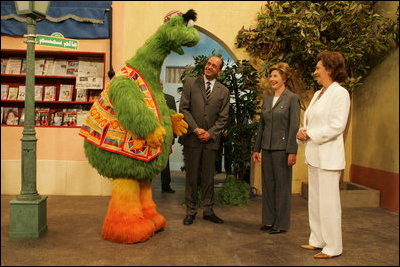
Suzanne Mubarak & Laura Bush.

Another Challenge from Kenya
Similarly, in response to a threat from Kenya that it was considering withdrawing from the 1929 agreement, the Egyptian Minister of Irrigation and Water Resources Mahmoud Abu Zeid said: "Egypt considers the withdrawal of Kenya from this agreement as tantamount to official declaration of war and a threat to its vital interests and national security." A Kenyan weekly quoted the Egyptian minister declaring in Addis Ababa that Kenya could be subject to sanctions by Egypt and the other eight members of the Nile River Basin Agreement. He said Kenya's position violates international law and customs "and we will not agree to it."
The Kenyan deputy foreign minister M. Watangola repeated his country's demand for a revision of this historic agreement because Kenya was not consulted prior to its being signed. He said eight Kenyan rivers flow into Lake Victoria, which is the main source of the Nile waters.

Ethiopia Asserts Rights to the Blue Nile
The Ethiopian Minister of Water Resources announced his country's intentions to develop close to 200,000 hectares (ha.) of land though irrigation projects and construction of two dams in the Blue Nile Sub-basin. He further stated that these projects would be the first phase of forty-six projects which Ethiopia proposed to execute along with ten joint projects which Egypt and Sudan proposed. The Ethiopian Minister of Water Resources retorted that the agreement to participate in the Nile Basin Initiative reserves Ethiopia's right to implement any project in the Blue Nile Sub-basin unilaterally, at any given time. He charged that the 1959 agreement between Egypt and Sudan impedes sustainable development in the basin and called for its nullification.

A Ugandan commentator Charles Onyango-Obbo wrote sometime back: "Egypt can't enjoy the benefits of having access to the sea, while blocking a landlocked country like Uganda from profiting from the fact that it sits at the source of the Nile." Uganda seems the least engaged in this battle for lack of diplomatic muscle, a visible lack of capacity for the state to initiate large projects and therefore has not given any direct threat to Cairo. Uganda's other disadvantage is also the role of IMF/World Bank whose influence in the running of the economy is enormous through budget support. Egyptian Intelligence also has classified the Ugandan state as unable to pose an immediate strategic threat and therefore contained.This means Egypt does not need to use threats of military action when it can diplomatically sabotage the development of strategic interests of Uganda through her sole source of direct financing. It is different with Kenya, Ethiopia and Tanzania countries that have moved fast to bring on the Chinese growing global influence in strategic investments. Uganda is still waiting in the wings because of her two decade alignment with the West. The state in Uganda has not made a bold step to bring on board the Chinese government growing economic muscle in her foreign policy because her multi-lateral and bilteral donors are mainly from Western Europe. Problem is Egypt is strongly allied to the US & Britain on mutual long term interests.The governments above are in a way directly involved in the economy through public interventions meaning they can finance big projects thus Egypt's tough response. Uganda is another case. Only the government can ponder about its state resignation at this glaring economic espoinage by Egypt and the donor community and re-align its foreign policy to address development contraditions.Through economic espionage, Egypt potentially is stiffling social-economic development because of her diplomatic foot work in Washington and London. It means, leaving strategic investments to private investors can be sabotaged through financial incetives by state as well as withdrawal of financing committments by International Credit Institutions with a more aggressive establishment in Cairo. Uganda technically is a victim of this to the greatest disadvantage as state planners wait for IMF/World Bank Instructions.In otherwords, we have to raise the bar of diplomatic engagement as well start looking at our mandate critically as a state like Kenya, Ethiopia and Tanzania have done.

While east African countries are eager to make greater use of the river, Egypt fears any threat to its lifeblood. Most of Egypt's population lives in the Nile valley - on 4% of the country's land - and any fall in the water level could be disastrous. From the Egyptian perspective, any change in the volume of its water could have devastating effects on Egypt. The vast majority of Egyptians live in a valley which is about 4 percent of the Egyptian territory, and 95 percent of Egypt's water resources are derived from the Nile.

Nevertheless, Egypt expressed its irritation with any project, arguing that under the 1929 agreement it has the right to veto any project - agricultural, industrial, or power - that could threaten its vital interests in guaranteeing its annual share of the river waters. While Egypt is handling the issue diplomatically, Egyptian officials stressed that "the diplomatic dialogue does not mean that Cairo does not consider any number of other options, if necessary." In diplomatic parlance, "other options" do not exclude the use of force. Tanzania has not budged. The Deputy Permanent Secretary in the Tanzanian Ministry of Water and Livestock Development, Dr. C. Nyamurunda, said that Tanzania's sentiments about the legality of the water agreement are well known. He emphasized that "other countries also believe that the treaties [NWA] were illegal but they are to cooperate in negotiations, although they are not restricted from using the waters of the Nile."


An estimated 160 million people in 10 countries depend on the river and its tributaries for their livelihoods. Within the next 25 years, the population in the Nile basin is expected to double, and there is a growing demand to harness the river for agricultural and industrial development.
ADiplomacy
The Nile treaty was drawn up at a time when Egypt was a British satellite, regarded as strategically crucial by London because of the Suez canal, which controlled access to India. The agreement is now in effect enforced by international donors, who are reluctant to advance funds for major river projects that will upset Egypt, a key Arab ally of the US in the Middle East.Sub-Saharan countries cannot match Egypt's diplomatic clout, but they face a dilemma as a major untapped resource rolls through their territories.

"We have reached a stage where all the Nile basin countries are confronted by domestic development challenges," said Halifa Drammeh, a deputy director of the United Nations environment programme. "How many people have access to safe water? How many have access to sanitation? There is a tremendous pressure on these governments to sustain the needs of their populations, and to raise their standard of living.

"After all, there is nothing we can do in life without water. Wherever there is sharing, there is potential for conflict."

The Nile is shared by ten countries – Burundi, Democratic Republic of Congo, Egypt, Eritrea, Ethiopia, Kenya, Rwanda, Sudan, Tanzania and Uganda –- with a combined population of about 300 million, about 160 million of whom live within the boundaries of the Nile Basin. The ten countries that share the Nile waters include some of the world's poorest, with annual per capital income of less than $250.

The Pressures for Change

Population pressures, frequent draughts, and increasing soil salinity have intensified the demands by the Nile Basin countries to renegotiate the 1929 agreement. Not deterred by Egyptian reluctance to negotiate the 1929 agreement, or even Egyptian threats, and constrained by financial hardships, some Nile Basin countries are determined to implement projects that would tap into the sources of the Nile.
The Nile Basin Initiative notwithstanding, member countries are forging ahead with their own projects and challenges. Droughts are difficult to forecast, even in the beginning of the crop season. Building dams to store water is not unlike a bank savings account, to be used at a time of need. While Egypt has secured its agriculture with the building of the Aswan Dam, it has been reluctant, if not belligerent, when other countries on the Nile Basin sought similar solutions.

Water for Oil
A senior Kenyan parliamentarian suggested that the Nile water should be sold to Egypt and Sudan for oil. He said that the time has come to replace the Nile agreement with a new agreement to allow the members to benefit from the Nile's waters. He added: "We have presented our natural resources to Egypt and Sudan free without them doing anything in return. We need to sell to them as they sell to us." The Egyptian treated the idea as "stupid" because the two countries have vested rights, rather than customers who would buy the water.

Egypt Accuses Hidden Fingers
In addition to Tanzania and Kenya, Ethiopia and Uganda are also demanding the abrogation of the 1929 agreement and a bigger share of the Nile waters. Egypt accuses "hidden fingers known to the Egyptian side [which] are openly inciting the traditional allies of Egypt in the Nile Basin to annul the agreement, arguing that it is incompatible with the population and political developments that have transpired in the last 75 years." The anonymous senior Egyptian official who has made the allegation about the "hidden fingers" stressed that any change in the agreement was inconceivable and warned that "any infringement of the agreement would suggest that the African countries do not respect regional obligations."

Egypt's Alternatives
To deal with the threat to its vital oil supply Egypt has four alternatives. Some are not mutually exclusive:

· Reduce waste through improved irrigation system.

· Price water at market rates.

· Maintain the status quo as long as feasible.

· Resort to the use of force.
Reduce Waste Through Improved Irrigation System
According to a study by the World Bank, 96.44 per cent of the economically active population in Egypt is engaged in agriculture. It is the highest percentage in the Middle East, with Morocco in second place with 92.61 percent of active population in agriculture. By contrast, the corresponding ratios for Tunisia and Lebanon are 60.87 and 10.35 percent, respectively. As a result, much of the water is used in agriculture, which contributes proportionately a small percentage to GDP. In Egypt, 88% of the water is consumed in agriculture which, as a sector, contributes only 14 percent to GDP, while 8 percent of water used in industry contributes 34 per cent of GDP. The report suggests that "from a narrow macroeconomic perspective, rationale of justifying the allocation of water to agriculture over industrial and other sectors is weak."


Price Water at Market Rates
While the region remains one of the most water-scarce regions in the world, the cost of water for irrigation is set at below cost recovery levels. Egyptian agriculture is entirely dependent on irrigated land. The government provides irrigation water free, except of cost recovery of on-farm investment projects. Annual irrigation subsidies are estimated at $5 billion. In Egypt, irrigation subsidies are often rationalized as a means of offsetting low farm prices controlled to keep down urban food prices.Water pricing and subsidies are such that they lead to waste in agriculture and provide little incentive for conservation techniques.
Maintain the Status Quo
Egypt's third option is to seek a status quo while tolerating some changes on the margin. To do so, Egypt must continue to maintain a pro-American and pro-Western orientation to discourage them and organizations controlled by them, such as the World Bank, from financing costly water projects such as dams or power projects in any of the riparian countries, which they themselves cannot finance through internally-generated resources.
Resort to the Use of Force
The last and least likely alternative is to resort to the use of force to uphold Egypt's right to exercise the veto power on activities that it deems dangerous to its national interests. Egypt's saber rattling cannot be taken too seriously, certainly not by the African countries themselves. Indeed, as one Egypt daily pointed out, "the harsh language adopted by Abou Zeid … might not be working…" Not only does Egypt lack the military capacity to strike at countries two thousand miles outside its borders, but it will be hard pressed to justify a military action to enforce the provision of a 75-year old agreement concluded to satisfy colonialist considerations and priorities but dissatisfy the needs of the countries upstream. A Kenyan father of two, who owns eight ponds for fish farming, was quoted as saying: "If the Egyptians try to invade Kenya for the sake of its water we are ready to die for our rights. Kenya must forget the Nile agreement and return to the commercial consumption of the Lake Victoria Lake."